There is no list. That is the first thing to know about the botanicals of Vermouth di Torino. The IGP regulation, signed in 2017 after two centuries of informal practice, requires only one ingredient by name — Artemisia absinthium or Artemisia pontica, grown or gathered in Piedmont — and otherwise leaves the recipe to its maker. Everything else is grammar: an unwritten convention learned by reading old manuals, tasting old bottles, and standing in the shadow of producers who have been arranging the same alphabet of herbs since the time of Carpano.
The Piedmontese herbalist Arnaldo Strucchi, in his early twentieth-century manual Il Vermouth di Torino, lists more than thirty botanicals as the city's working repertoire. Modern producers — Cocchi, Carpano, Martini, Cinzano, Antica Torino, Pio Cesare — each select their own twenty to thirty from that pool, and what makes a vermouth Torinese is not which botanicals are present, but the proportion in which they speak. A vermouth is a sentence. The botanicals are its words.
The five families
Despite the apparent variety, almost every classical recipe organises itself into five recognisable groups. The first is bittering: the spine of the drink. Wormwood gives the spine, but is rarely alone — gentian root, cinchona bark and rhubarb root extend it, each contributing a different register of bitterness, from the camphoraceous sharpness of Artemisia to the slow, mineral bitterness of cinchona.
The second is aromatic herbs: chamomile, sage, marjoram, hyssop, thyme. These are the alpine and Mediterranean herbs that grow within a hundred kilometres of Turin. They give the drink its lift — the green, breathing top notes that vanish first in the glass and that, when correctly balanced, make a vermouth feel like a place rather than a recipe.
The third is citrus: sweet and bitter orange peel, lemon, sometimes bergamot or cedro. Citrus is the gift of Genoa, the port through which the city's spice trade passed for four centuries. Citrus brightens the bitter spine and ties the herbs together, the way salt ties a stew.
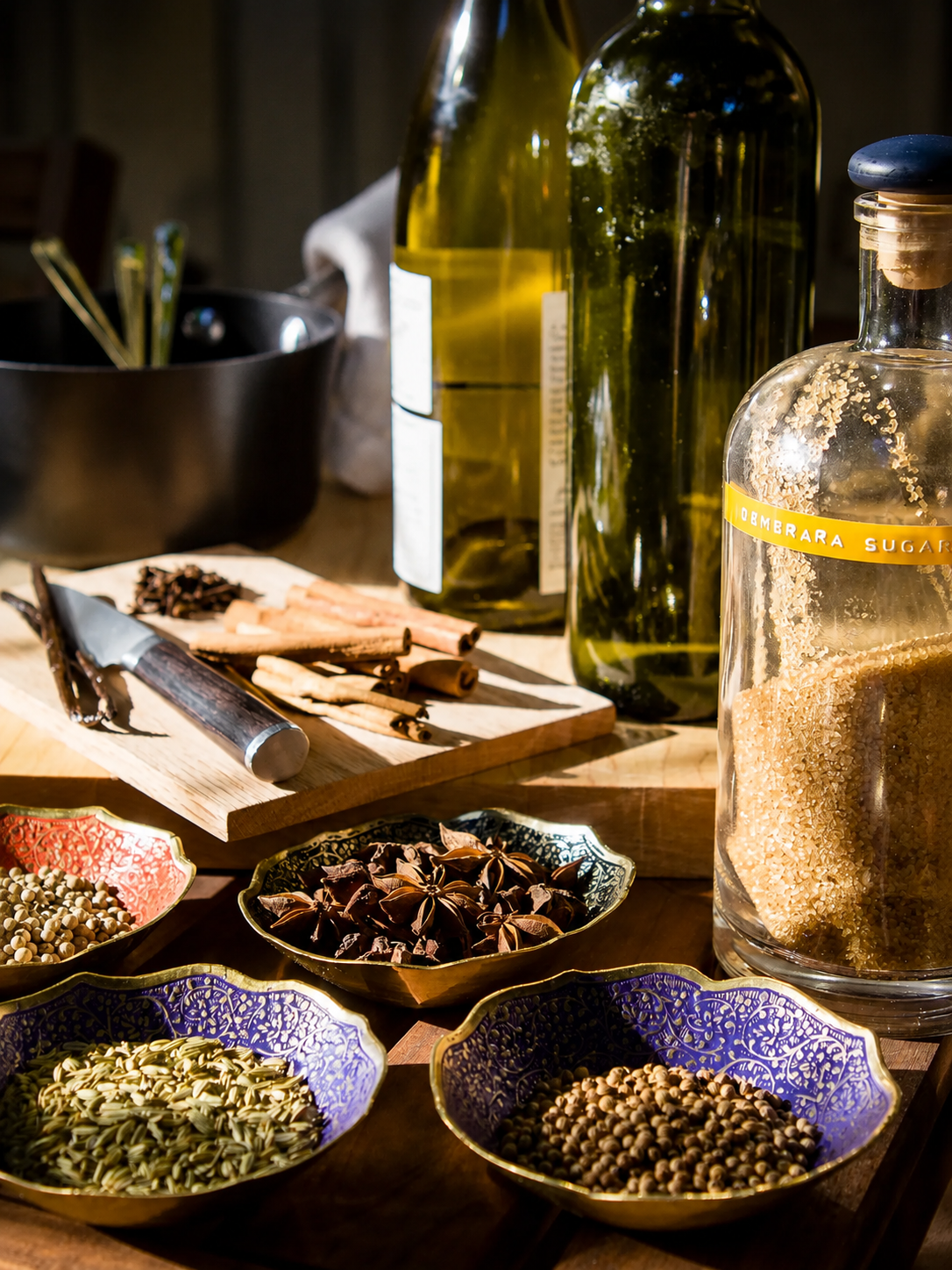
The fourth is spice: cinnamon, clove, cardamom, nutmeg, mace, coriander. These are the colonial-era arrivals — the spices that European apothecaries first imported as medicines and that, by the time Carpano opened his shop in 1786, had become standard in any well-stocked liquoreria. They give a vermouth its warmth, its winter weight, the thing the nose registers as Italian rather than French.
The fifth is roots and rare botanicals: angelica, calamus, iris, galangal, tonka bean, cassia. These are the foundation tones — the notes you do not consciously taste but that the drink would feel hollow without. They are the bass line beneath the melody.
"Vermouth is the union of two cultures: the herbalist culture and the oenological culture." Fulvio Piccinino, Il Vermouth di Torino
The periodic table of vermouth
What follows is a working list of twenty-four botanicals — drawn from Strucchi's catalogue, cross-checked against contemporary disciplinari and the published recipes of Cocchi, Martini Riserva, and Antica Formula. It is not exhaustive. It is the alphabet most often used, arranged here as a periodic table by family. Click any element for a short reading.
The Botanicals
Tap an element to read its entry.
Reading the proportion
The interesting part is not the list. The list is, at this point, almost public. The interesting part is the balance — the unwritten proportion that producers refer to as the ricetta, and that no two houses share. A traditional Vermouth di Torino Rosso, from the published notes of nineteenth-century manuals, runs roughly fifty per cent bittering, twenty per cent aromatic herbs, fifteen per cent citrus, ten per cent spice, five per cent roots — but those numbers are gravity, not law. A dry vermouth might lean Mediterranean and citrus-forward; an amaro-leaning rosso might double the wormwood and add a quinine-rich cinchona for backbone.
What unites them, across all styles, is a quiet rule: no single botanical should be identifiable in the glass. If you taste clove, the maker has used too much clove. If you taste gentian, the recipe has slipped. The point of a vermouth is that the herbs should sound like a chord, not a list — a single colour with depth, not a sequence of voices in a row.
What the regulation does — and doesn't — protect
The Vermouth di Torino IGP, recognised by Italian decree in 2017 and registered as a US certification mark in late 2023, requires that the wine base be Italian, that the production take place in Piedmont, that the alcohol sit between 16 and 22 per cent, and that the Artemisia species used be grown or gathered in Piedmont itself. The Superiore category goes further: at least half the wine base, and at least two botanicals beyond wormwood, must be Piedmontese.
What the regulation does not do is fix the recipe. There is no list of required botanicals beyond Artemisia, no mandatory ratio, no reference flavour profile. This is — depending on whom you ask — either a generous protection of the maker's craft or a quiet failure to define what makes a Torinese vermouth recognisably Torinese. In practice, the answer comes from below: from the houses that chose to keep the Strucchi alphabet, from the small producers who source their chamomile in Pancalieri and their gentian from the Val Chisone, and from the bartenders in the city's old caffès who can taste the difference between a Cocchi and a Carpano with their eyes closed.
What remains
The botanicals of vermouth are not, in the end, a recipe. They are a shared vocabulary — a small alphabet that has remained almost unchanged since the late eighteenth century, when a young Carpano stood in a Turin bottega arranging twenty-odd jars in front of a barrel of Moscato. The houses come and go. The proportions shift. The vocabulary holds.
Pour a Vermouth di Torino at six in the evening, in the amber light of a Galleria, and what you are tasting is not a flavour. It is a sentence written by thirty hands, none of whom signed it. The grammar is silent because everyone agreed on it long ago, and because — for a city that has been doing this for two hundred and forty years — there is no need to say out loud what the glass already knows.