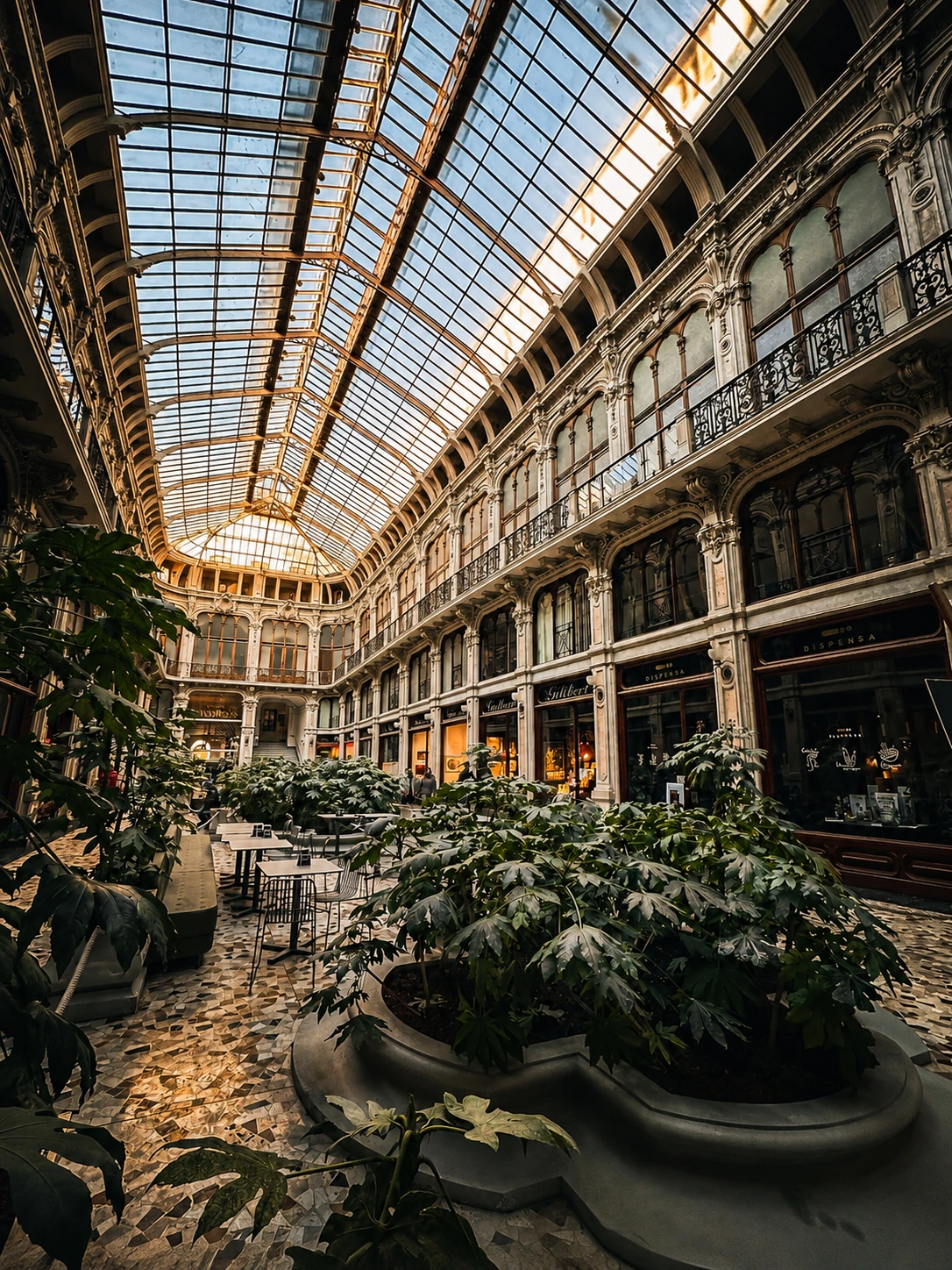
There is a moment, three or four steps in, when the sound changes. You leave the north-east corner of Piazza Castello — trams, pigeons, the flat acoustic of a very large square — pass beneath a modest arch under the arcades, and the noise simply stops. What replaces it is a soft, high, slightly echoing hush: the sound of a room that is fifty metres long, fourteen wide, and roofed in glass at eighteen metres. This is the Galleria Subalpina, and the abrupt change of register is the whole point of it. It was built to be a room, in a city that already had more arcades than any other in Europe.
Most visitors cross it in ninety seconds on their way from Piazza Castello to Piazza Carlo Alberto, photograph the roof, and move on. That is a fair use of it. But the Subalpina rewards a slower reading than that: it is a nineteenth-century financial instrument disguised as a drawing room, it contains the oldest cinema in Turin, it was very nearly destroyed in August 1943, and it was rebuilt so faithfully that almost nobody notices. This is the story of the room, the men who commissioned it, and the tenants who never left.
One hundred and fifty years
From the first Turin arcade to the Subalpina today
Nine moments, from a demolished predecessor to the current restoration. Tap a stage to learn more.
Nine stages · tap to explore
A bank that wanted a room
The Galleria Subalpina is not, strictly speaking, its name. On paper it is the Galleria dell'Industria Subalpina, and it is called that because the Banca dell'Industria Subalpina — newly founded, cash-rich, and keen to be seen — underwrote the entire cost of construction. In exchange, the bank got its name carved into the most fashionable new address in the city. It is a piece of corporate sponsorship so modern in conception that it feels anachronistic, and it happened in 1873.
The problem the bank set out to solve was mundane. A dense block stood between Piazza Castello, the ceremonial heart of Savoy Turin, and Piazza Carlo Alberto behind it. Cutting a passage through would create a shortcut — and shortcuts, in the commercial logic of the nineteenth century, are rent. But the model was not a shortcut at all. It was the Parisian passage: the covered, glazed, artificially lit shopping street that had colonised the centre of Paris from the 1820s onward and that Walter Benjamin would later spend a lifetime failing to finish writing about. Milan was building its own, vastly larger version at exactly the same moment; the Galleria Vittorio Emanuele II is roughly four times the length of the Subalpina and was completed three years after it.
Turin, characteristically, went smaller and got there first. The Subalpina was the city's second covered arcade, after the Galleria Natta of 1858, and it outlived it: the Natta was pulled down in the 1930s when Via Roma was rebuilt. Two more would follow — the Galleria Umberto I in 1890 and the Galleria San Federico in the 1930s — but neither has the Subalpina's particular quality, which is that it feels less like a street with a roof than like a room that has mislaid its house.
The architect nobody remembers
The man who drew it was Pietro Carrera (1835–1887): Sicilian by birth, Turinese by training and choice, an architect and engineer with an eclectic hand and an unlucky posterity. Much of his built work in Turin has been demolished, altered beyond recognition, or absorbed into later buildings. He designed workers' housing on Corso Regio Parco, the prefecture at Cuneo, a scheme for diverting water from the Stura for motive power. Almost none of it is what he is remembered for, because the Galleria Subalpina swallowed his reputation whole. It is a strange fate for an engineer: to be known for one room.
He drew it in 1873 as a hall on two levels — shopfronts below, a balustraded gallery above, the whole thing lit from a pitched roof of glass carried on latticed ribs of iron. That combination, masonry and stucco below, industrial glazing above, is the signature of the period: the same structural logic as a railway station, dressed in the costume of a palace.
A section through the hall
The anatomy of a passage
Schematic transverse section. Not to scale — the proportions are exaggerated for legibility.
Tap any element to isolate it in the drawing.
The hand that did the stucco
The decorative apparatus — the swags, the brackets, the mouldings that make a glass-roofed shopping street look like the state rooms of a palace — is eclectic in the precise nineteenth century sense: Renaissance vocabulary and Baroque exuberance mixed without apology, because the period believed in choosing from the whole of history rather than obeying one part of it.
It is generally attributed to a sculptor named Rubino, and here we have to be honest about a small tangle in the record. Several sources, including the Italian Wikipedia entry, name Edoardo Rubino — a Turinese sculptor of real distinction, but one who was born in 1871 and would therefore have been three years old at the inauguration. Other sources give Pietro Rubino. The likeliest explanation is a confusion of names propagated between guidebooks, with the 1874 work belonging to an earlier hand and the more famous Edoardo attached to it retrospectively. We flag it rather than resolve it: the Subalpina is well documented in its dates and its finances and surprisingly loose in its attributions.
A room that pretends to be a palace, roofed like a railway station, paid for by a bank.
Who lives under the glass
An arcade is only as good as its tenants, and the Subalpina's have an unusual habit of staying. The confectioner arrived the year after it opened. The cinema descends from a cafe-concert of 1898. Two of them — Baratti & Milano and Dispensa — also appear in our itinerary through the historic vermouth bars of Turin, which tells you something about how much of the city's drinking history is concentrated in these fifty metres. What follows is who you will actually find behind the glass, and what each is for.
Behind the arches
Eight addresses, one roof
From an 1858 confectioner to a bookshop that moved in last year. Tap a name to open it.
Eight tenants · tap to open
August 1943
On the night of 8 August 1943, Allied bombers struck the block bounded by Via Cesare Battisti, Via Carlo Alberto and Via Accademia delle Scienze. The residential buildings took the worst of it. The east flank of the Galleria was caught in the blast: the glass roof, the shops beneath it, the cinema and the Baratti & Milano premises all sustained serious damage, recorded in photographs now held in the city's historical archive. The cinema stayed dark for three years.
What happened next is the reason the arcade feels so untroubled today. Turin rebuilt it on Carrera's original drawings, with only minor variants — no modernising, no opportunistic enlargement, no 1950s reinterpretation. The city that would shortly demolish a great deal of its own fabric chose, in this one instance, to put the room back exactly as it had been. Visitors are routinely surprised to learn that anything happened here at all.
It is worth holding that alongside the other date in this neighbourhood. Five minutes' walk away, under the arcades of Piazza Castello, the bombing of July 1943 destroyed the small shop where Antonio Benedetto Carpano had invented vermouth in 1786 — and that one was never rebuilt. Today only a plaque marks it. Two buildings, two raids, two decisions. We tell that story in full in The Shop Where Vermouth Was Born.
The Galleria on film
Directors have always liked it, for an obvious reason: it is an interior that looks like an exterior, fully lit by daylight, with a built-in vanishing point at either end. Local film histories record scenes shot here for Dario Argento's Four Flies on Grey Velvet (1971), Peter Collinson's The Italian Job (1969) — the film that did more for Turin's on-screen reputation than any tourism campaign since — and Luigi Comencini's The Sunday Woman (1975), adapted from the Fruttero and Lucentini novel that is still the best portrait of the Turinese bourgeoisie ever written.
Fifty metres, and what waits at either end
The Subalpina's real trick is its siting. It is a very short building that connects two enormous subjects, and walking it takes you from the Savoy state to the Italian one in under a minute.
The Piazza Castello end
You emerge under the arcades facing Palazzo Madama, with the Royal Palace to your left and, to your right, the run of porticoes where — at what was then Piazza delle Fiere — a twenty-two-year-old herbalist first poured a glass of vermouth in 1786. Caffè Mulassano is at your shoulder. Caffè Baratti & Milano's other entrance is on the square itself. In a hundred metres you can cross the entire founding mythology of the Italian aperitivo, which is roughly what our seven-bar itinerary asks you to do.
The Piazza Carlo Alberto end
Step out the other way and you are looking at the back of Palazzo Carignano — the Baroque front of it, by Guarino Guarini, faces the other direction, but this rear façade is where the first parliament of a unified Italy sat, and the whole complex is part of the UNESCO listing of the Savoy Residences. Beside it stands the National University Library. And at Via Carlo Alberto 6, a few steps further, Friedrich Nietzsche took lodgings in 1888, wrote Ecce Homo, and — so the story has always gone, though historians treat it with caution — collapsed in this square on 3 January 1889 after throwing his arms around a horse.
Two exits, four minutes apart, and between them a bank's advertisement from 1874.
Practical
How to visit the Galleria Subalpina
- Where
- Between Piazza Castello 29 and Piazza Carlo Alberto, through Via Cesare Battisti. The Piazza Castello entrance is under the porticoes, beside Caffè Mulassano.
- Cost
- Free. A public passage, not a monument — no ticket, no booking.
- When
- Late morning for the light through the glass; after dark for the shopfronts. Sunday afternoon is the quietest hour.
- If it rains
- The best wet-day address in central Turin: an arcade, a cinema, a bookshop, a chocolate counter and a wine bar within fifty metres.
- Photography
- Shoot down the long axis from either entrance — the roof composes the frame for you. The upper gallery gives the better angle on the ironwork.
- How long
- Ninety seconds to cross. Ninety minutes if you stop, which you should.
Living above the glass
We should declare an interest. Casa Vermouth is inside this building — on Via Cesare Battisti, on the Galleria's own floors, above the roof line. It is the reason the house exists in the form it does: not a hotel with a view of a monument, but a set of rooms within one.
What that means in practice is mostly a matter of sound. The arcade below has its own daily rhythm — the shutters going up around ten, the coffee machines, the flurry at aperitivo hour, the last of the cinema audience crossing the marble near midnight — and then a silence that no street in a city centre can offer, because a covered arcade closes at both ends. Guests tend to notice it on the second morning, when they realise they have not heard a car.
It also means the ordinary business of a stay happens inside a listed nineteenth-century interior. Breakfast is a hundred and fifty steps away, at a counter that has been serving it since 1875. So is the bookshop, the tea merchant, the cinema, and the wine shop. We built the house around that proximity rather than around a lobby.
You can read more about the residence itself on Casa Vermouth — and if you would rather start with the drink the city invented, begin with Carpano's bottega, five minutes north.
A hundred and fifty-one years after a bank cut a hole through a city block to make a shortcut and accidentally made a room, the Galleria Subalpina is doing what it was built to do: sheltering people who have nowhere in particular to be. That was the whole nineteenth-century idea of the passage — an interior that belongs to no one and is open to everyone, where the weather is suspended and the only thing being sold is time.
Turin has never been very good at advertising itself. It built this in eighteen months, called it after a bank, put the drawing away for a century and a half, and then quietly finished it. Go and stand under the middle of the roof for a minute. It is the least crowded remarkable thing in the city.